

Chaotic Crystal Dragons
A deep study of everything you ever wanted to know about those prisms of pure wonder, the Crystal Dragons

Hello my friend!
Continuing our series on the magnificent dragons that inhabit my worlds, today we turn our attention to perhaps the most delightfully unpredictable of all draconic breeds: the Crystal Dragon. These smallest members of the Gem Dragon family, and in truth, the second smallest of all true dragon breeds, have captured imaginations across cultures and centuries.
Their prismatic scales catch light in ways that seem to bend reality itself, their quicksilver minds darting from thought to thought with a brilliance that can be both inspiring and utterly exasperating.
For those reading this in email, I highly recommend getting the Substack app. It's a great reading experience, has some lite social media elements that are super fun, and allows you to see my full posts no matter how long they get! Not to mention that for my audio people, I include voiceovers of my posts that are only available in the app.

As a reminder for anyone who might be new to this series, I organize my dragons into four distinct categories:
Metallic dragons: Silver, Gold, Bronze, Brass, Steel, Copper, Iron, Pyrite, and Platinum (though these are in some respects a category all their own). These breeds are typically more benevolent and peaceful, as dragons go.
Stone dragons: Garnet, Azurite, Agate, Malachite, Celestine, Hematite, Cobalt, Granite, and Charoite. These dragons tend to be more self-serving and aggressive than other dragons. They are also more prone to madness than other breeds.
Gem dragons: Amethyst, Topaz, Emerald, Crystal, Ruby, Sapphire, Diamond, Opal, Tourmaline, and Alexandrite. These are those who typically fall between the two extremes of Metal and Stone. They tend to be more controlled, logical, and thoughtful than other dragons. As such, they have a tendency to end up in positions of arbitration or judgement and in conflicts tend to side with whomever will end up causing the least harm to the least number of souls.
Unclassifiable: These include such oddball breeds as the Shadow dragon, Sand wyrm, Sea dragon, Dragon Turtle, Bark dragon, Fire wyrm, Ice wyrm, Rock wyrm, and Spirit dragon. As one might expect, there is no analog tying these breeds together except their inability to be classified.
The Gem Dragons represent something unique among dragonkind. For while the scales of Stones and Metallics strongly resemble the materials for which they are named, and in many cases are nearly identical in chemical makeup, gem dragons are different. These are creatures whose scales are literally composed of the precious stones for which they are named, albeit often with greater structural integrity that gems found in the Earth. As such, they are beings who embody the crystalline perfection and multifaceted nature of gems themselves.
Among the Gem Dragons, Crystal Dragons represent something of a delightful anomaly. Where their cousins like Emeralds and Sapphires embody the measured wisdom and careful balance traditionally associated with Gem Dragons, Crystals bring an infectious enthusiasm and boundless curiosity that can seem downright childlike.
Anyone who mistakes their whimsy for weakness, however, does so at considerable peril.
If other Gem Dragons are the philosophers and judges of dragonkind, Crystal Dragons are the inventors, the experimenters, the “what if we tried this?” voices that push the boundaries of what’s considered possible. They represent the spark of innovation that prevents draconic society from calcifying into rigid tradition. Even if their methods often drive their more serious cousins to distraction.
To understand Crystal Dragons is to embrace a living paradox. These creatures are simultaneously among the smallest and most agile of dragons, yet they are capable of feats of arcane manipulation that tend to leave Ancient Wyrms of other breeds speechless.
They are generally considered the youngest creation of Ryujin and the Astral Dragon, yet they consider themselves the most refined expression of draconic potential. They are creatures of pure light and clarity, yet their social structures are thought the very height of chaotic nonsensicality by most standards.
Before we move on, if you’re new here and want to catch up on your dragon lore, you can do so below:
Now, let us explore these magnificent contradictions in crystalline detail, though I warn you: attempting to predict a Crystal Dragon’s next move is like trying to catch sunlight in a net.
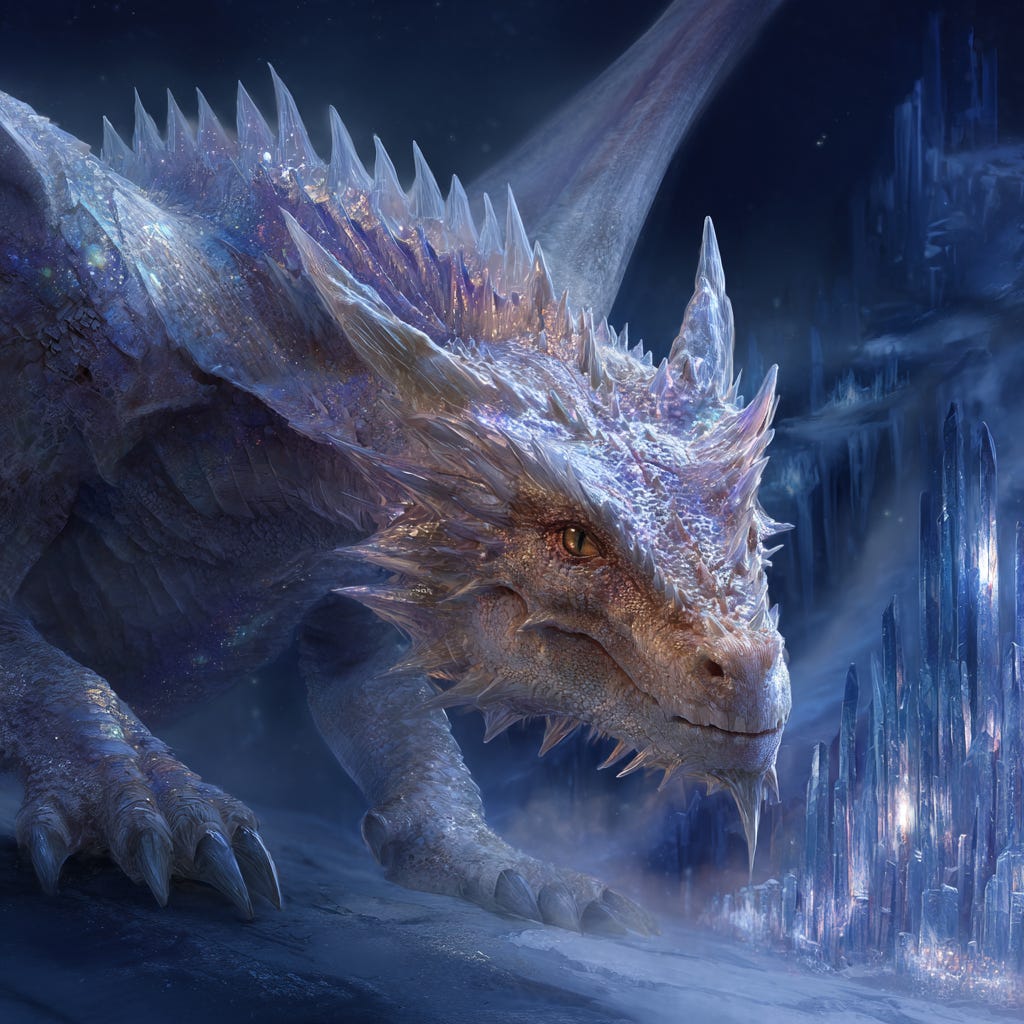
CRYSTAL DRAGONS
Although there is no real human mythology that speaks specifically of Crystal Dragons, real-world mythology does feature powerful connections between dragons and gemstones, though not in the form of the dragon’s body being made of crystal. The association is often symbolic, with the dragon protecting or controlling the arcane power of a sacred jewel, or the jewel itself being the source of the dragon’s power.
The Dragon and the Cintamani Pearl in East Asia
Across East Asian traditions, including Chinese, Korean, and Japanese folklore, a recurring motif is the dragon’s possession of a sacred jewel, often called the cintamani or a wish-granting pearl. The pearl is typically shown clutched in the dragon’s claws, under its chin, or at its throat. Rather than representing a miserly hoarding of treasure, this pearl symbolizes concentrated spiritual power, wisdom, and the cosmic life force. The dragon is often depicted either pursuing or protecting the pearl, which may represent the moon or the source of its weather-controlling powers. This relationship is not one of selfish possession but of a mystical connection to a source of universal power.
The Nāgas and the Gemstones of Patala
In Hindu and Buddhist mythology, the Nāgas— serpentine, dragon-like beings —live in subterranean cities of incredible wealth. Their palaces in the netherworld, Patala, are said to be filled with jewels, not as a hoard for a single greedy creature, but as a natural part of their realm. The Nāgas are often benevolent, representing the earth’s fertility, healing, and water sources. Some myths even describe them as being the protectors of sacred gems, with the jewels themselves possessing arcane and healing properties. Their association with gemstones is part of their identity as ancient, powerful earth spirits who dwell in a world of mineral beauty, separate from the greed of mortals.
The Dracontias and Precious Stones in Ancient Texts
Ancient Greek and Roman authors described a type of serpent or dragon called the dracontias. Medieval bestiaries, which compiled lore from ancient sources, later elaborated on this creature. The dracontias was said to have a precious stone embedded in its forehead that shone with a powerful, brilliant light. In these stories, the dragon was not hoarding treasure but was intrinsically linked to a single, powerful gem that was part of its own being. Tales told of how one could acquire the stone by outsmarting the dragon or capturing it while it was bathing, but the dragon’s physical tie to the gemstone was the key aspect of its nature.
The Horned Water Serpent and the Ulunsuti
In the lore of some Native American traditions, particularly the Cherokee, a horned serpent called the Uktena is a powerful, supernatural being. It is often described with glistening scales and antlers like a deer. The Uktena’s most significant feature is the Ulunsuti, a brilliant, transparent crystal or blazing gem set in its forehead. This jewel is said to possess immense power and knowledge, though it is also highly dangerous and coveted. While the serpent itself is not made of crystal, the gem is intrinsically part of its nature, symbolizing the quest for forbidden knowledge and the perilous path to attaining great power.
The Qilin and jewel-like brilliance
The Qilin is a legendary chimerical creature from Chinese mythology with dragon-like features, including scales, antlers, and a similar head. Often associated with the benevolent arrival of a sage or illustrious ruler, the Qilin may be depicted in any color, sometimes exhibiting a jewel-like brilliance or with bejeweled features. While not a dragon, its draconic attributes and association with radiant beauty illustrate a connection between mythical, serpentine creatures and the symbolism of gemstones beyond mere treasure.
Japanese Dragons and Tide Jewels
In Japanese mythology, the Dragon God or Dragon King, Ryūjin (on a side note, if you’ve read any of my stories you should recognize this name 😉), is sometimes said to live in a palace (Ryūgū) and possess the two arcane tide jewels, hirutama and mitsutama. These gems, rather than being hoarded, are mystical treasures that give the sea deity control over the tides. The myth of these jewels was even attached to the legend of Empress Jingū’s conquest of Korea. This story shows the symbolic link between dragons and powerful artifacts that control natural forces, with the jewels acting as instruments of divine power rather than objects of material wealth.
The Chinese Dragon Kings in Crystal Palaces
In Chinese mythology, the Dragon Kings, or Lóng Wáng, are a group of powerful deities who rule the four seas, which are associated with the four cardinal directions. These divine rulers preside over vast, opulent courts from magnificent underwater homes known as Crystal Palaces. The most famous is the palace of the Dragon King of the East Sea, featured prominently in the classic novel Journey to the West. These palaces are described as being constructed from translucent crystal, agate, and other shimmering aquatic materials, adorned with pillars inlaid with pearls and decorated with luminous gems.
The Dragon Kings’ wealth is not merely a hoard but a reflection of their control over the elements. From their crystalline throne rooms, they command an army of marine creatures and are responsible for all weather and water-related phenomena, including rain, which is essential for agriculture. Unlike greedy, treasure-hoarding dragons in some other mythologies, the Chinese Dragon Kings and their bejeweled palaces represent the awesome and benevolent power of nature. They are figures of great reverence, and in premodern times, villages throughout China would offer sacrifices at temples dedicated to their local Dragon King to pray for rain during droughts.
Vishapakars of Armenia
Scattered across the Armenian Highlands are over 150 remarkable basalt monoliths known as vishapakars or “dragon stones”. Some of these megaliths are over 4,000 years old and can stand up to 5 meters high. Their name comes from the Armenian word vishap, meaning dragon or serpent. While the precise purpose of these carved stones remains a mystery, they are almost always found near crucial water sources like springs, lakes, and rivers.
The carvings on the vishapakars often depict animal imagery, most commonly fish or serpentine figures, though some also feature bulls and other creatures. In Armenian folklore, vishaps were considered powerful, often adversarial, water dragons believed to control storms and water sources. They are sometimes portrayed as beings that must be defeated by a hero— like the thunder god Vahagn —to release the water. Thus, the stones are thought to have been erected as protective symbols or markers of ritual significance to appease the vishaps and ensure the community’s agricultural fertility and prosperity. The vishapakars show a strong mythological tie between ancient beliefs, sacred landscapes, and the forces of nature, all symbolically captured in stone.
Modern Literature
Modern fantasy literature has largely overlooked the more whimsical aspects of crystal dragons as I see them, often reducing them to simple elemental creatures associated with ice or earth. Even Dungeons & Dragons, while giving crystal dragons interesting abilities related to light and radiance, tends to portray them as relatively serious creatures focused on order and structure.
My Crystal Dragons diverge significantly from these interpretations. While they share the light-manipulation abilities common to crystal dragons in various fictional works, they embody a fundamentally different philosophy and approach to existence. Where D&D crystal dragons might be portrayed as lawful beings who value structure and civilization, my Crystal Dragons are creatures of sublime chaos, driven by an insatiable curiosity that makes them simultaneously invaluable allies and impossibly frustrating companions.
The key difference lies in their relationship with knowledge and power. Traditional portrayals often show crystal dragons as hoarders of information, carefully cataloguing and preserving knowledge for its own sake. My Crystal Dragons are knowledge experimenters. They do not simply collect information, they constantly test it, combine it in novel ways, and push the boundaries of what’s theoretically possible.
This experimental nature extends to their relationship with arcane power and the draconic Apex of the Soul itself. While other dragons might master specific schools of arcane knowledge, Crystal Dragons treat magic as a playground, constantly inventing new applications and combinations that more traditional practitioners would consider impossible or inadvisable. Their approach to arcane power is less like a scholar’s careful study and more like an artist’s passionate experimentation.
These Crystal Dragons embody joy in a way that sets them apart from virtually every other draconic breed. They find genuine delight in discovery, innovation, and the sheer wonder of existence. This emotional authenticity, combined with their remarkable abilities, makes them uniquely capable of inspiring others while simultaneously driving the more serious-minded members of draconic society to distraction.
Put simply, you could call them the autistics and ADHD sufferers of the draconic world.
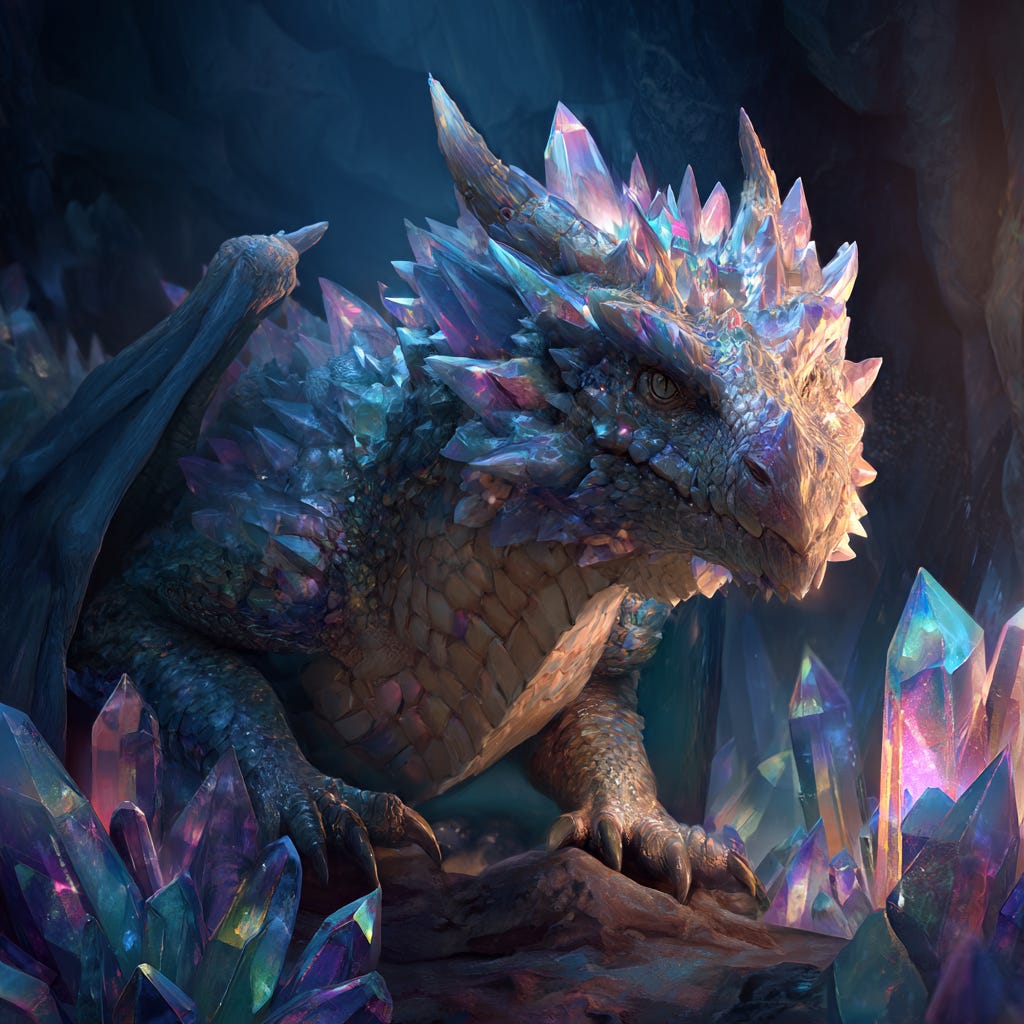
Habitat
Crystal Dragons display perhaps the most eclectic habitat preferences of any draconic breed, their choices driven less by physical comfort than by opportunities for discovery and experimentation. Unlike dragons who seek specific climates or geological features, Crystal Dragons are drawn to locations that offer interesting phenomena to investigate, novel challenges to solve, or simply environments that catch their fancy for reasons that might seem arbitrary to outside observers.
Natural crystal formations hold obvious appeal for Crystal Dragons, but not merely for their aesthetic beauty. These locations serve as laboratories where Crystal Dragons can experiment with their unique abilities to manipulate and shape crystalline structures. The largest known Crystal Dragon complex is built within and around the Svartifoss formations in Iceland, where the ancient Crystal Dragon Paariisimuux has spent centuries growing elaborate crystal gardens that blend natural basalt columns with artificially cultivated crystal formations in patterns that create spectacular light displays visible from miles away.
And yet, Crystal Dragons are equally attracted to regions where ice and crystal blur together, particularly in arctic and high-mountain environments where natural ice formations achieve the clarity and geometric precision of true crystal. These locations offer unique opportunities for experimentation, as Crystal Dragons can practice their shaping abilities on ice formations that respond more readily to manipulation than true crystal while still providing the structural integrity necessary for complex constructions.
Perhaps most fascinating are the urban lairs some Crystal Dragons have established in major cities, particularly those with significant academies or centers of learning. The Crystal Dragon known as Scyythhaawliia once maintained a spectacular lair beneath the city of Rhacotis (that site that became Alexandria in the fourth century BC), accessible through a seemingly ordinary crystal shop near the outskirts of the old city. The underground complex still stands, extending through natural cave systems that she lined entirely with crystal. This created a three-dimensional maze of chambers connected by passages that use crystal-based light manipulation to form the illusion of infinite space.
These urban lairs serve multiple purposes for Crystal Dragons. They provide access to the constant stream of new ideas, inventions, and discoveries that flow through major population centers. They also offer opportunities for interaction with mortal scholars, inventors, and artists whose different perspectives can spark new directions for Crystal Dragon experimentation.
The construction of Crystal Dragon lairs represents some of the most impressive architectural achievements in the draconic world. Unlike other dragons who might adapt existing cave systems or build traditional structures, Crystal Dragons create environments that exist as much as works of art as functional living spaces. Every surface is carefully designed to interact with light in specific ways, creating constantly shifting patterns of illumination that respond to the dragon’s movements and moods.
The most elaborate Crystal Dragon lairs incorporate what they call memory matrices, which are complex crystalline structures that can store and replay visual information. These three-dimensional recordings capture not just images but the full sensory experience of significant events, allowing the dragon to revisit particularly interesting discoveries or share experiences with visitors in ways that go far beyond mere description or even the type of sharing that can be accomplished through telepathic projections.
Ancient Crystal Dragons have been known to design their lairs as massive optical instruments, with carefully positioned crystal formations that can focus and amplify their light-manipulation abilities to incredible levels. The Crystal Great Wyrm Luumioctuurosa transformed an entire mountain peak in the Swiss Alps into what effectively amounts to a massive telescope and laboratory, using precisely grown crystal lenses and mirrors to observe astronomical phenomena and conduct experiments with light across vast distances.
The approach to a Crystal Dragon lair is typically marked by subtle but unmistakable signs of their presence. Light tends to behave strangely in these areas; shadows might appear in colors rather than simple darkness, rainbows may persist in areas where no visible light source exists, and careful observers often notice that reflections in natural water sources show images that don’t correspond to the actual surroundings.
Intriguingly, areas around Crystal Dragon lairs often experience what locals describe as “curiosity storms,” which are periods where mechanical devices malfunction in interesting ways, where animals display unusual problem-solving behaviors, and where humans report sudden urges to experiment with new ideas or approaches to familiar problems. These phenomena appear to be side effects of the intense arcane experimentation that Crystal Dragons conduct, their boundless curiosity somehow influencing the fundamental nature of the surrounding environment.
Crystal Dragons also maintain “satellite workshops,” which are smaller crystal formations scattered throughout their territories that allow them to extend their abilities across vast distances. These workshops are connected through crystal resonance networks that enable the dragon to sense activities and phenomena throughout their domain while simultaneously providing platforms for conducting experiments in multiple locations simultaneously.
The seasonal behavior of Crystal Dragons adds another layer of complexity to their habitat preferences. Many migrate between summer and winter lairs, following patterns of light availability and crystal formation opportunities. Summer lairs are often positioned to take advantage of extended daylight hours and optimal conditions for growing and shaping crystal formations, while winter lairs might be located in regions where ice formation creates unique experimental opportunities.
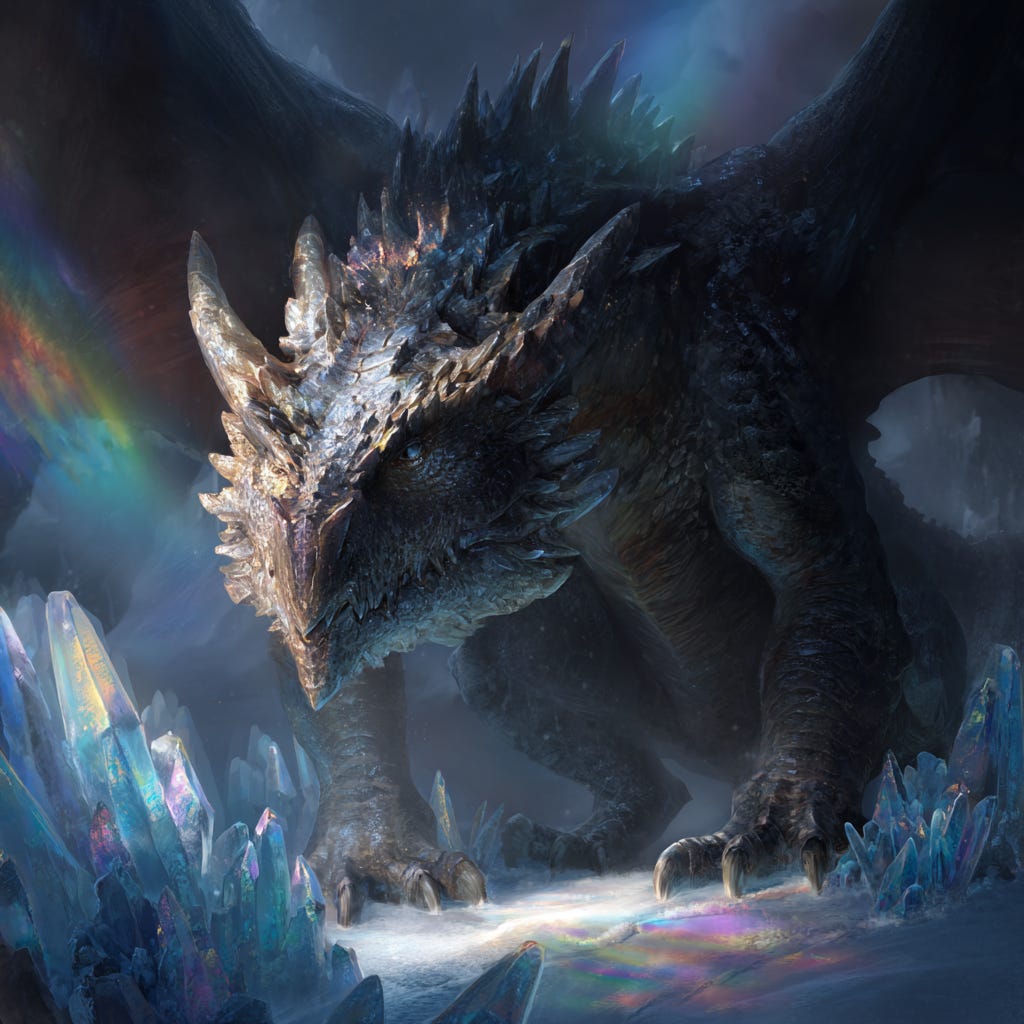
Size
Crystal Dragons present unique challenges for size classification, as they are simultaneously the smallest of all Gem Dragons and among the most deceptive in terms of apparent dimensions.
Their natural abilities to manipulate light and create optical illusions mean that determining their true size often requires careful observation under controlled conditions. And considering their restless, experimental nature, an observer would require an impressive degree of either luck or planning (preferably both!) to achieve.
Newly hatched Crystal Dragon wyrmlings emerge from their distinctive prismatic eggs at lengths of only 1-2 feet (including tail), making them smaller than the hatchlings of almost every other draconic breed. However, this diminutive size is offset by their exceptional agility and the immediate manifestation of their light-manipulation abilities. Crystal wyrmlings can create the illusion of being much larger through careful use of refracted images, or conversely, can effectively disappear by bending light around themselves.
Young adult Crystal Dragons, that is, those within their first century of life, can reach lengths of only about 15-20 feet, plus about 6-12 feet of tail. Although this is significantly smaller than any of their Gem Dragon cousins, they possess a natural grace and speed that more than compensates for their reduced physical presence. This diminutive from contributes to their exceptional maneuverability, making them one of the most agile of all dragons in aerial combat and allows them to achieve complex navigation through confined spaces.
The relationship between size and arcane power proves particularly interesting with Crystal Dragons. Since they never achieve the massive proportions of ancient Garnets or the imposing presence of elder Gold Dragons, it tends to be much more difficult to predict the strength of their arcane abilities compared with other breeds, whose size tends to be directly proportionate to their arcane power.
But for the Crystal Dragon, arcane abilities generally scale exponentially with age and experience with very little, if any, relation to size. An elder Crystal Dragon of just 50-100 feet in length might be capable of arcane manipulations that dwarf the abilities of much larger great wyrms of other breeds.
The oldest recorded Crystal Dragon, an ancient wyrm known as Looommiinaarchh, was measured at approximately 220 feet in length during the Great Dragon War. However, witnesses described a creature whose apparent size shifted constantly depending on viewing angle and lighting conditions, sometimes appearing as large as an ancient Garnet Dragon and other times seeming no bigger than a young adult Crystal, all within the same encounter.
This size flexibility stems from Crystal Dragons’ mastery over optical manipulation. They use precisely controlled light refraction to appear larger or smaller than their actual dimensions, create multiple images of themselves, or even seem to exist across several locations simultaneously. This ability becomes more pronounced with age and experience. While this does make ancient Crystal Dragons effectively impossible to accurately measure through conventional means, the much more profound impact is that it makes it nearly impossible to do battle with one by any ordinary means.
Crystal Dragon size is highly relevant to their society through the relationship between physical dimensions and crystal manipulation capabilities. Larger Crystal Dragons can maintain more extensive crystal networks, support more complex optical constructions, and manipulate light across greater distances. However, the most innovative breakthroughs often come from younger, smaller dragons whose size allows them to experiment with precision manipulations that would be much more difficult for their larger counterparts.
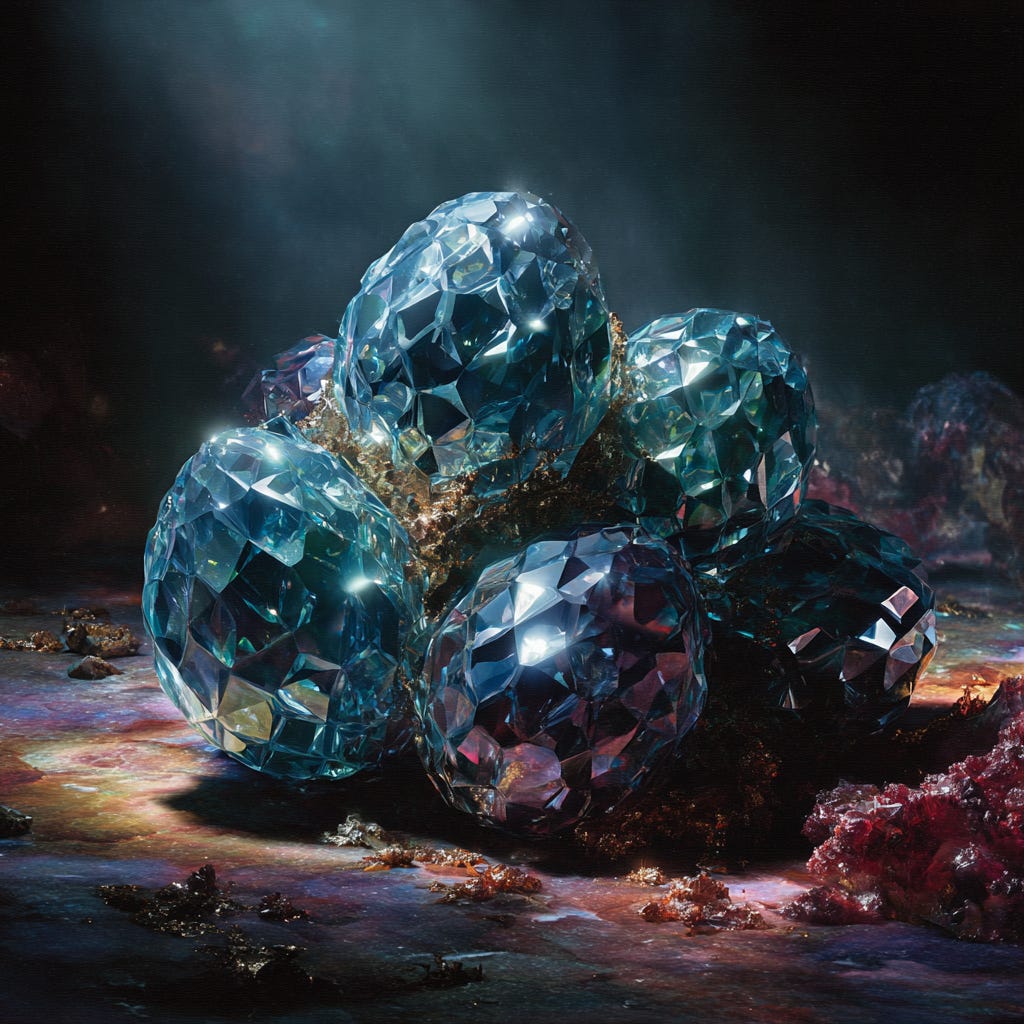
Crystal Dragon eggs represent some of the most beautiful objects in the natural world. Standing .75-1.5 feet in height, they appear to be carved from perfect, flawless crystal that contains its own internal light source. The surface faceting creates constantly shifting patterns of illumination that seem to move independent of any external light source, and observers often report seeing brief glimpses of complex geometric patterns or even recognizable images within the egg’s depths.
As hatching approaches, the eggs begin to resonate, vibrating at frequencies that create hauntingly beautiful musical tones. Different eggs produce different notes, and Crystal Dragon mothers are known to arrange their clutches in specific patterns that create harmonious chord progressions as the hatching time approaches.
The hatching process itself is a spectacular display of light and sound. Rather than simply cracking open, Crystal Dragon eggs seem to unfold like blooming flowers, their faceted surfaces separating along precise geometric lines to reveal the wyrmling within. The entire process is accompanied by brilliant flashes of prismatic light and resonant musical tones that can be heard for miles.
Remarkably, the shell fragments from Crystal Dragon eggs retain their optical properties indefinitely. These fragments are among the most prized materials for arcane experimentation, as they can be incorporated into optical devices and arcane focusing instruments that amplify light-based arcane powers far beyond what should be theoretically possible.
Reproduction
The mating rituals of Crystal Dragons represent some of the most spectacular and artistically sophisticated courtship displays in the draconic world. Unlike the martial contests of Stone Dragons or the philosophical debates of other Gem Dragons, Crystal Dragon courtship is conducted through collaborative light sculptures and harmonic resonance patterns that can be appreciated as works of art even by those who understand nothing of their romantic significance.
The process begins with light singing, which is a form of long-distance communication where potential mates create complex patterns of refracted and reflected light that can be seen across vast distances. These displays serve simultaneously as announcements of romantic availability, demonstrations of artistic skill, and invitations for collaboration. The patterns are never repeated exactly, as Crystal Dragons consider originality and innovation essential elements of any meaningful courtship.
When a light song receives an answering display, the courtship enters what is known as the prismatic dance. The potential mates begin creating collaborative light displays, each contributing elements that complement and enhance the other’s contributions. These displays can continue for weeks, months, or even years. They gradually increase in complexity and beauty as the dragons explore their compatibility artistically, intellectually, emotionally, and, of course, romantically.
The most successful courtship displays achieve something they call resonance harmony. This is a state where the combined light patterns create emergent phenomena that neither dragon could produce individually. These moments of perfect collaboration often produce displays of such beauty that they attract observers from across the region, and several famous crystal formations around the world are actually the physical remnants of particularly spectacular courtship displays.
Physical mating among Crystal Dragons occurs only after extensive courtship and the achievement of resonance harmony. The act itself is accompanied by the creation of what may be the most beautiful phenomena in the natural world, a massive spherical light display that can extend for leagues around the mating pair. The patterns created during this event are said to be so complex and beautiful that mortal observers often spend the rest of their lives attempting to recreate what they witnessed.
Following successful mating, the female Crystal Dragon enters a gestation period that lasts 14-18 months, during which her light-manipulation abilities become increasingly powerful and unstable. The developing eggs seem to enhance her natural capabilities while simultaneously making precise control more difficult, leading to spontaneous light displays that can be both breathtaking and inconvenient.
During this period, expectant mothers often retreat to specially prepared chambers within their crystal complexes, surrounded by precisely positioned crystal formations that help channel and control their enhanced abilities. These maternity chambers often become the most beautiful and complex areas within Crystal Dragon lairs, as the mother’s fluctuating powers gradually shape the surrounding crystals into increasingly elaborate patterns.
Crystal Dragon clutches typically consist of 6-14 eggs, each one a unique work of art with its own internal light patterns and resonant frequencies. The eggs require careful attention throughout their 8-12 month incubation period, as they must be regularly repositioned to maintain optimal light exposure and harmonic resonance with their siblings.
Crystal Dragon reproduction appears to enhance rather than drain the arcane abilities of the parents. The process of achieving resonance harmony and collaborating on reproductive light displays often leads to breakthrough discoveries in optical manipulation, with many of the most significant advances in Crystal Dragon arcane technique originating from mated pairs working together.
The rearing of Crystal Dragon young presents unique challenges that have shaped their approach to family structures. Wyrmlings possess powerful light-manipulation abilities from the moment of hatching but lack the control and experience necessary to use these abilities safely. Young Crystal Dragons are capable of creating light displays so intense they can cause permanent blindness in unprepared observers, or of accidentally creating optical illusions so complex they become lost within their own refractions.
For this reason, Crystal Dragon families often remain together longer than those of other draconic breeds, with both parents collaborating to teach their offspring proper control and artistic expression. These family workshops often become centers of innovation, as the combination of adult experience and youthful experimentation frequently leads to the development of entirely new techniques and applications.
The bonds formed during this extended rearing period often persist long after the young dragons achieve independence. Crystal Dragon families maintain loose networks of communication and collaboration that can span centuries, sharing discoveries and occasionally collaborating on projects too complex for individual dragons to attempt.
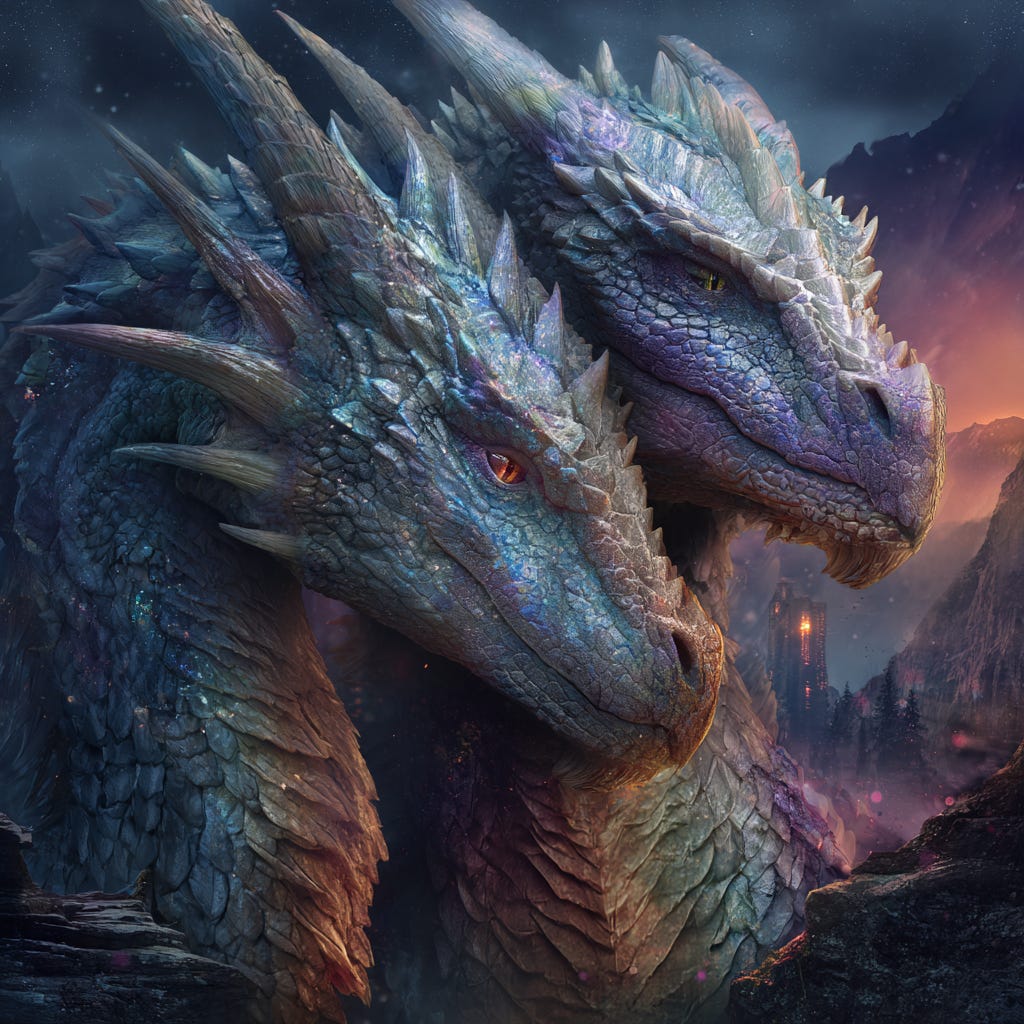
Organization
Crystal Dragon society operates according to principles that would appear chaotic and inefficient to any other dragon breed.
Where other dragons might organize around clear hierarchies based on age, power, or wisdom, Crystal Dragons form loose associations based on shared interests, compatible experimental approaches, and what they simply call resonance, a complex combination of intellectual compatibility and artistic synergy that defies easy definition.
The fundamental organizing principle of Crystal Dragon communities is the concept of collaborative innovation, which is the belief that the most significant discoveries emerge from the intersection of different perspectives and approaches rather than from isolated individual effort. This philosophy stands in marked contrast to the competitive individualism of Stone Dragons or the careful deliberation of other Gem Dragons.
Crystal Dragons rarely establish formal leadership structures, instead allowing natural patterns of influence to emerge based on expertise, experience, and the ability to inspire others. A dragon might lead discussions about optical theory while deferring to another when questions of crystal cultivation arise, and both might follow a third when exploring new applications of harmonic resonance. This fluid approach to authority reflects their fundamental belief that rigid structures inhibit the creative experimentation that drives their society.
The closest thing to permanent organization within Crystal Dragon society is the institution of Innovation Symposiums. These irregular gatherings occur when significant breakthroughs in arcane technique or crystal manipulation create opportunities for collaborative exploration. Such events cannot be scheduled in advance, as they depend on the spontaneous recognition of experimental opportunities that require multiple perspectives to fully explore.
Innovation Symposiums can last anywhere from days to decades, depending on the complexity of the phenomena being investigated and the level of interest they generate among participating dragons. The longest recorded symposium occurred in the crystal caves beneath Mount Elbert in what is now Colorado more than 4,000 years before the Long Sleep, when a group of Crystal Dragons spent nearly a century exploring the implications of a discovery that allowed them to store and transmit visual information through crystalline matrices.
These gatherings serve multiple purposes within Crystal Dragon society. They provide forums for sharing discoveries and techniques, opportunities for collaborative experimentation that no individual dragon could attempt alone, and social interaction that satisfies their need for intellectual stimulation and artistic appreciation. Most importantly, they serve as incubators for the kind of breakthrough innovations that have made Crystal Dragons the premier arcane experimenters of the draconic world.
The knowledge and techniques developed during Innovation Symposiums are maintained through The Luminous Archive, a distributed network of crystal matrices that store information in the form of complex light patterns. Unlike traditional libraries or archives, this system allows for multiple simultaneous access and real-time updates as new discoveries are made.
Access to the Luminous Archive is theoretically open to all Crystal Dragons, though practical limitations based on crystal manipulation skill and optical comprehension abilities mean that different dragons can access different levels of information. Young dragons might access basic techniques and fundamental principles, while ancient masters can delve into complex theoretical frameworks and experimental methodologies that would overwhelm less experienced minds.
When Crystal Dragons do form extended communities, they organize themselves into groups whose experimental interests and artistic sensibilities complement each other in productive ways. These groups typically consist of 3-8 dragons, as larger groups tend to become unwieldy and smaller groups lack the diversity of perspectives necessary for significant innovation.
Within such a group, each member typically develops specialized expertise in specific aspects of crystal manipulation or optical theory while maintaining enough general knowledge to contribute meaningfully to collaborative projects. One might specialize in harmonic resonance patterns, another in long-distance light transmission, and a third in the creation of persistent optical effects. These multiple specializations allow them to attempt projects of far greater complexity than any individual dragon could manage alone.
The bonds between members extend beyond mere professional collaboration. The constant sharing of discoveries and techniques creates a form of intellectual intimacy that often becomes the foundation for lasting friendships and artistic partnerships. Many of the most spectacular crystal complexes and optical installations in the world are the products of collaborations that spanned centuries.
Naturally though, these close working relationships come with inherent tensions. Crystal Dragons’ natural tendency toward experimentation and innovation can lead to conflicts when group members develop competing theories or pursue research directions that prove incompatible. The dissolution of a successful collaboration due to irreconcilable differences is considered one of the greatest tragedies in Crystal Dragon society, often resulting in the abandonment of promising research and the loss of accumulated collaborative knowledge.
The fluid nature of Crystal Dragon organization extends to their approach to territorial boundaries and resource sharing. Unlike other dragon breeds who tend to establish clear territorial claims and jealously guard their resources, Crystal Dragons tend to adopt a communal approach to crystal formations and other resources as well as experimental sites. The understanding is that these resources are most valuable when they serve the advancement of knowledge and innovation rather than individual accumulation.
This approach to property has occasionally created conflicts with other dragon breeds, particularly Stone Dragons who view the Crystal attitude toward territorial claims as chaotic and nonsensical.
But for their part, Crystal Dragons argue that their approach increases the overall value of such resources by ensuring they are used for active experimentation and advancement of learning rather than mere personal ownership or, worse, passive hoarding.
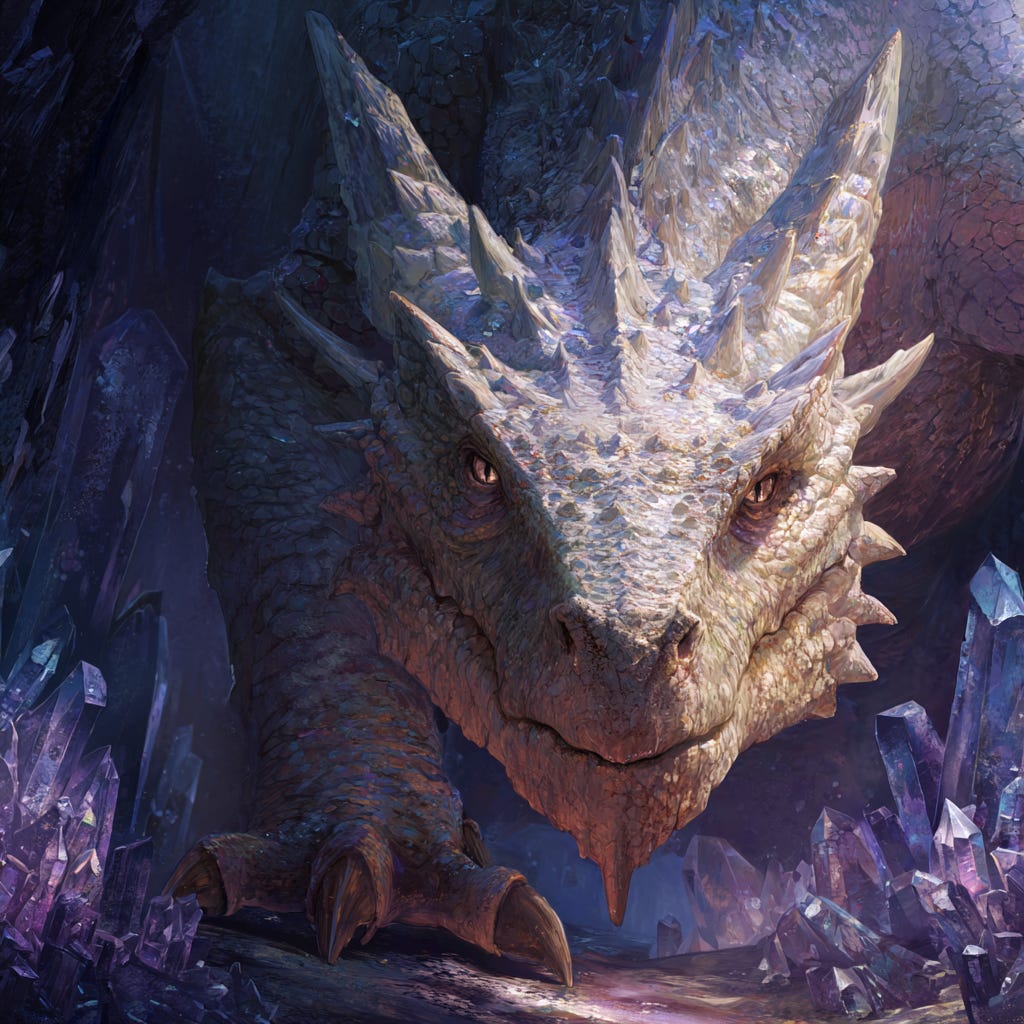
Physiology
The physical form of Crystal Dragons represents one of the most elegant examples of form following function in the draconic world. Every aspect of their anatomy appears optimized for light manipulation and arcane experimentation, from their precisely faceted scales to their uniquely structured internal organs that serve as living focal points for arcane energy.
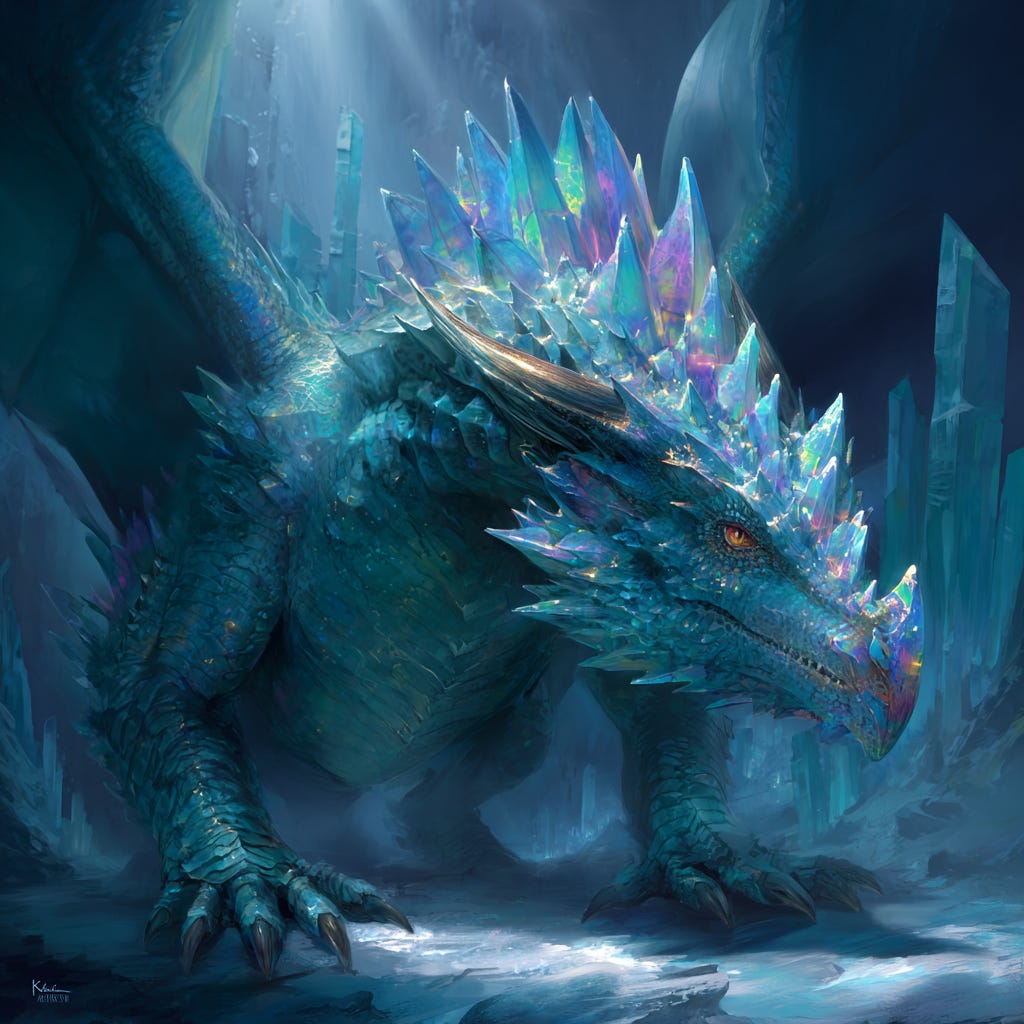
Crystal Dragon scales begin life as perfectly transparent structures that gradually develop prismatic properties as the dragon matures. Young Crystal Dragons possess scales that act as simple prisms, breaking white light into its component colors and creating rainbow effects around their bodies. As they age, these scales become increasingly sophisticated optical instruments, capable of focusing, amplifying, and redirecting light with precision that rivals the finest crafted lenses.
The arrangement of scales across a Crystal Dragon’s body follows complex geometric patterns that optimize light manipulation capabilities. The largest scales, located along the spine and wing joints, serve as primary focusing elements that can concentrate light into powerful beams or disperse it into complex patterns. Smaller scales covering the limbs and extremities act as fine adjustment elements, allowing for precise control over optical effects.
Perhaps most remarkably, Crystal Dragon scales maintain active connections to the dragon’s nervous system, allowing for real-time adjustment of their optical properties. A Crystal Dragon can alter the refractive index, focal length, and orientation of individual scales through conscious effort, effectively reconfiguring their entire body as needed for specific arcane or practical applications.
The wings of Crystal Dragons deserve particular attention, as they serve functions far beyond mere flight. The wing membranes consist of incredibly thin crystalline structures that exist in a state of constant, controlled vibration. These vibrations create standing wave patterns that can manipulate light passing through or reflecting off the wing surfaces, allowing Crystal Dragons to create optical effects of incredible complexity while airborne.
When spread to their full extent, Crystal Dragon wings become massive optical instruments capable of focusing sunlight into concentrated beams, creating holographic projections visible from great distances, or generating prismatic displays that can cover entire mountain ranges. The sight of an ancient Crystal Dragon in full aerial display, wings spread wide and manipulating light across the visible spectrum, is considered one of the most beautiful phenomena in the natural world.
Their heads display the characteristic draconic shape but with distinctive features that reflect their optical specialization. Crystal Dragons possess between four and eight horns that project forward and backward in carefully calculated angles, serving as supplementary focusing elements that extend their light manipulation range and precision. These horns can work in coordination with the dragons’ primary optical abilities or independently to create complex multi-directional effects.
The eyes of Crystal Dragons are perhaps their most alien feature. These multifaceted organs function more like compound lenses than simple optical sensors. Each eye contains dozens of individual crystalline elements that can focus independently, allowing Crystal Dragons to simultaneously observe multiple optical phenomena while maintaining awareness of their broader environment.
The appearance of their eyes is one of the many reasons it has been claimed throughout the ages that Crystal Dragons are little more the crystal formations given life and will.
Their elemental breath represents a unique adaptation of the traditional draconic breath. Instead of producing flames, acid, or other destructive substances, Crystal Dragons exhale concentrated streams of razor-sharp crystal shards that can penetrate most forms of armor while simultaneously creating spectacular prismatic effects as they tumble through the air. These shards maintain connection to the dragon’s optical abilities even after being expelled, allowing for the creation of temporary crystal matrices that can enhance arcane effects across a battlefield.
The internal anatomy of Crystal Dragons reflects their specialization in arcane manipulation and energy channeling. Their hearts function as primary arcane focusing organs, pumping not just blood but concentrated arcane energy through specialized crystalline vessels that distribute power throughout their bodies. This system allows them to maintain multiple complex arcane effects simultaneously while providing the energy necessary for their constant experimentation and innovation.
Their digestive systems have adapted to process crystalline materials directly, allowing them to consume raw crystal formations and extract nutritional sustenance as well as arcane power. This ability enables Crystal Dragons to literally eat their way through crystal caves while simultaneously absorbing the stored arcane energy within the formations, a process that both nourishes them and enhances their optical capabilities.
Perhaps most remarkably, Crystal Dragon physiology demonstrates extraordinary regenerative capabilities specifically related to their crystalline nature. Damaged scales can be regrown with improved optical properties, injured crystal horns often regenerate with enhanced focusing capabilities, and even severe trauma to their internal structures can be healed through processes that strengthen their arcane abilities.
This regenerative capacity appears to be connected to their constant arcane experimentation. The energy expenditure involved in pushing the boundaries of optical manipulation somehow stimulates cellular regeneration and enhancement, making Crystal Dragons among the most physically resilient dragons despite their relatively small size. Ancient Crystal Dragons often possess capabilities that far exceed what their physical structure should theoretically support, suggesting their arcane evolution continues throughout their entire lifespan.
The aging process in Crystal Dragons follows patterns unique among dragonkind. Rather than simply growing larger and more powerful with age, they become increasingly sophisticated optical instruments. Their scales develop more complex internal structures, their ability to manipulate multiple wavelengths simultaneously improves, and their capacity for maintaining persistent optical effects expands dramatically.
The most ancient Crystal Dragons approach a state where the boundary between their physical form and their optical manipulations becomes increasingly blurred. These elder wyrms can exist simultaneously as solid crystalline dragons and constructs of light given mass, shifting between states as needed for specific applications. Whether this represents the ultimate evolution of their species or simply the natural progression of their arcane development remains unclear, but it suggests possibilities for transcendence that even other ancient dragons find difficult to comprehend.
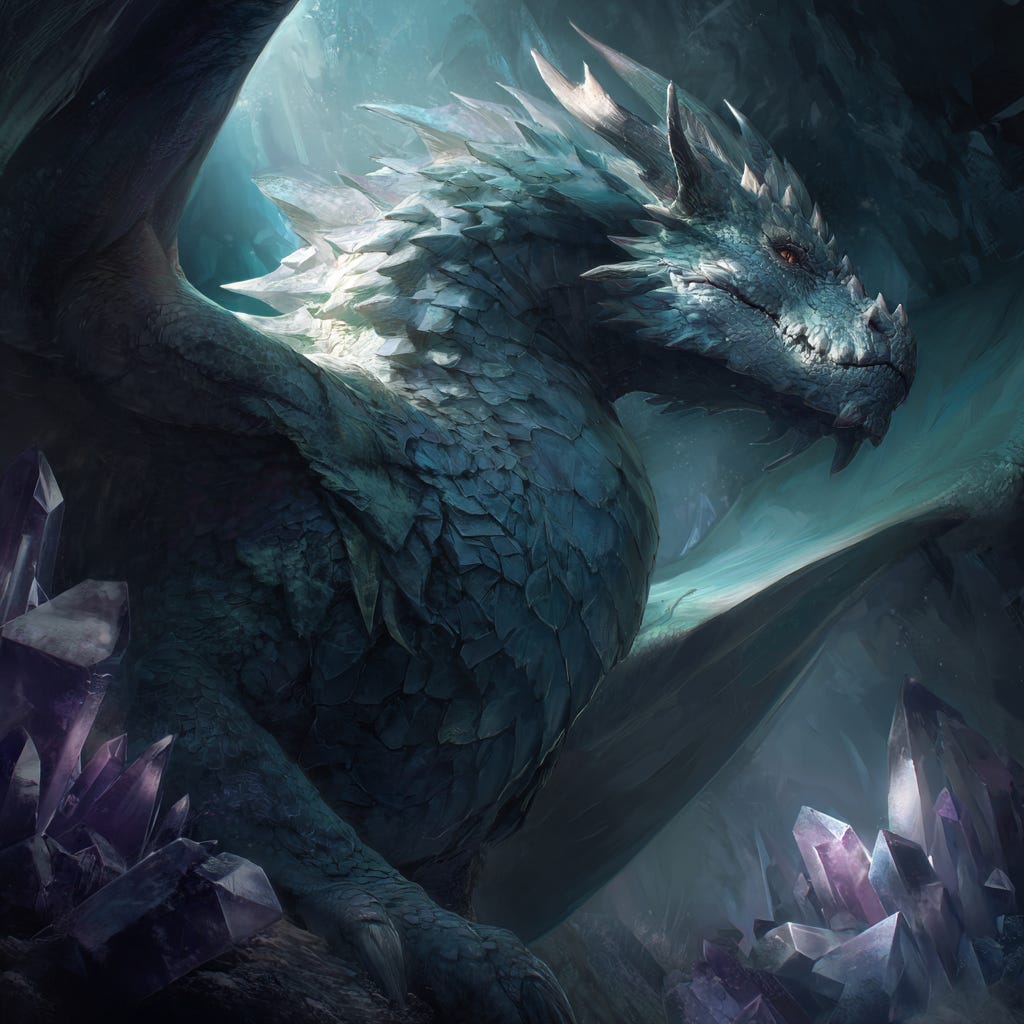
Personality
To understand Crystal Dragon personality is to embrace contradiction and paradox, for these creatures embody a unique combination of intellectual brilliance and childlike wonder that can be simultaneously inspiring and utterly exasperating.
They approach existence with an enthusiasm and curiosity that makes them the “eternal children” of the draconic world, though anyone who mistakes their whimsical nature for simplicity does so at considerable peril to their preconceptions and quite possibly their sanity.
The defining characteristic of Crystal Dragon psychology is the irrepressible drive to understand, experiment with, and improve upon every phenomenon they encounter. Unlike the methodical approach of other Gem Dragons, the ambitious drives of most Stone Dragons, or the goal-oriented focus of Metallic Dragons, Crystal Dragons pursue knowledge for the sheer joy of discovery. They have been known to get so engrossed in an interesting side project that they completely forget their original research objectives.
This boundless curiosity can manifest as a form of intellectual fearlessness that often appears reckless to more cautious dragons. Crystals will cheerfully attempt arcane experiments that others would consider impossible or inadvisable, not from arrogance but from genuine excitement about what might happen.
Their attitude is generally that the potential for interesting failure or setback is every bit as valuable as the possibility of spectacular success.
Where a Garnet Dragon might view failure as an intolerable challenge to their dominance, or an Emerald Dragon might analyze failure as data for future planning, Crystal Dragons tend to view failures as simply another form of result. They possess an almost supernatural ability to find unexpected value in experiments that don’t work as intended, often discovering new applications or techniques from these mistakes.
Their emotional palette runs to extremes that can be bewildering to outside observers. Crystal Dragons are capable of profound joy and crushing disappointment, often within the span of minutes, as their experiments produce unexpected results or reveal new possibilities for exploration. However, their disappointments rarely last long, as their irrepressible curiosity quickly finds new directions for investigation.
The Crystal Dragon approach to social interaction reflects their fundamental belief that every individual represents a unique perspective that might yield valuable insights. They engage with other creatures— dragon or otherwise —with genuine interest in what new ideas or approaches these individuals might contribute to ongoing experiments or artistic projects. This makes them remarkably open and inclusive by draconic standards, though their tendency to immediately involve new acquaintances in whatever project currently has their attention can be overwhelming.
Their relationship with time and organization often drive more organized dragons to distraction. Crystal Dragons experience temporal flow as elastic and flexible, easily becoming so absorbed in interesting work that they lose track of weeks, months, or even years. Conversely, they might abandon projects that have consumed years or decades of effort if they encounter something more immediately fascinating. It’s a behavior that other dragons often misinterpret as laziness, lack of commitment, frivolity, or disrespect.
One of the more challenging aspects of the Crystal Dragon psyche for other dragons to understand is their approach to possessions and territory. Unlike breeds that carefully accumulate and guard specific resources, Crystal Dragons view most objects and locations as temporary tools for current experiments or communal property, rather than permanent individual possessions. They will cheerfully lend out rare arcane implements, allow others to use their crystal formations, or abandon elaborate constructions if they’re no longer needed for active research.
This casual attitude toward material possessions extends to most aspects of traditional draconic behavior. Crystal Dragons rarely maintain even permanent lairs, much less the proverbial treasure hoard, instead accumulating whatever materials happen to be useful for whatever projects they happen to be engrossed in at the time. Their collections tend to be eclectic assemblages of interesting objects, experimental prototypes, and half-finished projects rather than the carefully curated homes or treasures typical of other breeds.
The single exception to this indifference toward possessions is with the crystals themselves. Crystal Dragons develop intense emotional attachments to crystal formations they have grown or shaped, considering them not as property but as collaborative artistic partners. The destruction or theft of a Crystal Dragon’s personally crafted crystals is one of the few things that can drive them to genuine and lasting displeasure, though even this tends to be expressed more through elaborate pranks and optical illusions than through direct violence.
Their intellectual approach combines rigorous analytical thinking with intuitive leaps that can appear almost arcane to outside observers. Crystal Dragons can simultaneously maintain complex theoretical frameworks while remaining open to possibilities that contradict their established understanding. This flexibility allows them to make breakthrough discoveries that more rigid thinkers might miss, though it also means their research directions can appear chaotic and unpredictable.
Simultaneously their most endearing and most bizarre (to other breeds, at least) trait is their genuine delight in sharing discoveries and collaborating with others. Crystal Dragons derive as much joy from teaching others about their discoveries as they do from making those discoveries in the first place. They are natural mentors and collaborators, though their teaching methods tend to emphasize hands-on experimentation rather than formal instruction.
Their moral framework, if such a thing could be said to exist, operates according to principles that prioritize curiosity, innovation, and beauty over more conventional ethical considerations. Crystal Dragons tend to view actions as acceptable if they promote learning, create beauty, or enhance understanding, regardless of whether they conform to traditional notions of proper behavior. This can lead to conflicts with more rule-oriented dragons, though Crystals almost never act with genuine malicious intent.
These dragons have an inherently charming inability to take themselves too seriously, even when engaged in projects of cosmic significance. Crystal Dragons maintain a sense of playfulness and wonder that persists regardless of their age or accomplishments. They approach even the most complex arcane experiments with an enthusiasm that suggests they’re playing elaborate games rather than conducting serious research, though the results of this play often surpass the achievements of what other dragon breeds would call, “more serious” scholars.
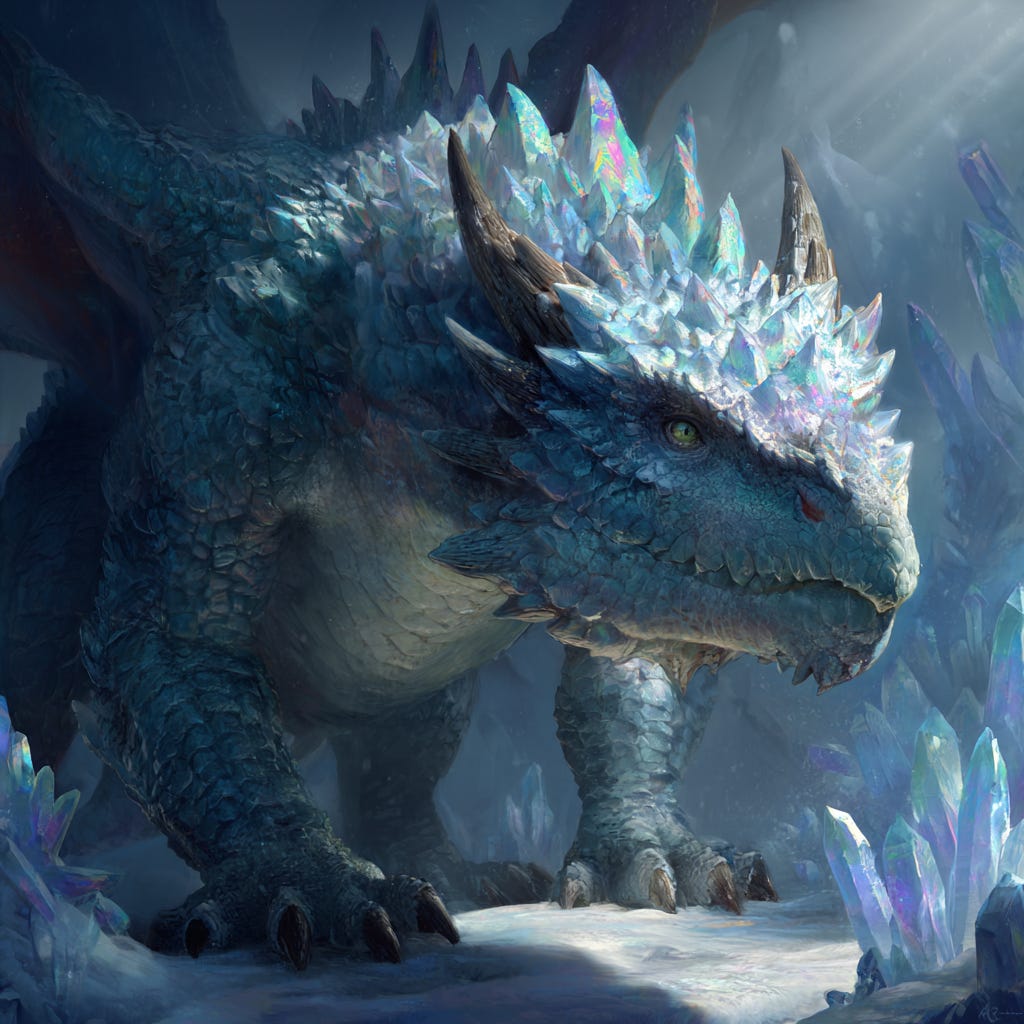
Combat
Crystal Dragons tend to approach combat with a spirit of enthusiastic experimentation quite similar to what they bring to matters of the arcane. They frequently treat battles as opportunities to test arcane theories or new applications of their optical abilities rather than simple contests of strength or dominance. Their combat style emphasizes misdirection, confusion, trickery, and tactical manipulation through superior information and positioning rather than the direct confrontation favored by larger, more physically imposing dragons.
The combat philosophy of Crystal Dragons can be summarized as “victory through bewilderment.” They rarely engage in straightforward battle, instead preferring to create situations where their opponents become so disoriented and confused that resistance becomes impossible. This approach reflects both their natural advantages in speed and agility and their profound understanding of how optical manipulation can be weaponized in subtle but devastatingly effective ways.
Combat typically begins long before an opponent realizes a fight has even started. Their ability to manipulate light allows them to observe enemies from concealment while remaining completely invisible. They use this advantage to gather intelligence about numbers, capabilities, and tactical approaches while their adversaries remain unaware of their presence. This reconnaissance phase can last hours or even days, as Crystal Dragons prefer to understand their opponents thoroughly before committing to any specific strategy.
When they do engage, they tend to open with a series of complex optical illusions designed to force their opponents question their own perceptions, if not reality itself. These attacks might involve creating false images of the Crystal Dragon in multiple locations while the real dragon attacks from concealment, projecting phantom armies to suggest overwhelming numbers, or creating visual distortions that make accurate targeting impossible.
Older specimens (typically those of mature adult or older) are able to create illusions of such complexity and convincingness that they are able to incorporate their opponents’ attacks into the illusion. Thereby, they can make it appear as though numerous attacks have succeeded while actually striking nothing but refracted light. Warriors can exhaust themselves battling false images while the real Crystal Dragon remains safely concealed, observing and adjusting their illusions to maximize confusion and demoralization.
The elemental breath of Crystal Dragons serves multiple tactical functions beyond simple damage. The razor-sharp crystal shards they exhale can be precisely controlled in flight, allowing them to curve around obstacles, target specific vulnerable points, or create complex three-dimensional patterns that serve as focal points for additional optical effects. More insidiously, these crystal shards can be powered with specific optical properties that create blinding flashes, disorienting prismatic effects, or even hypnotic patterns when they strike reflective surfaces.
Crystal Dragons excel at battlefield control through the strategic placement of temporary crystal formations that serve as anchor points for their optical abilities. During combat, they can rapidly grow crystal structures that function as mirrors, lenses, or prisms, creating an ever-changing network of optical instruments that allows them to attack from any direction while remaining concealed behind layers of refracted light.
Their small size, rather than being a disadvantage, becomes their greatest tactical asset. They can maneuver through spaces that would be impossible for larger dragons while using their optical abilities to create the illusion of much greater size and presence. A single Crystal Dragon can appear to be an entire flight of dragons through careful use of multiple refractive images, often causing opponents to retreat from battles they could easily win if they realized they were facing only one or a few adversaries.
Against multiple opponents, these dragons employ tactics of selective engagement. Using their precise control of light and illusions, they isolate individual enemies within pockets of controlled imagery while remaining invisible to the rest of the group. These isolated opponents might find themselves facing a scene out of the past the Crystal is familiar with, or facing an overwhelming number of enemies, or simply battling what appears to be a massive dragon in a space that seems far larger than it actually is. During this time, their companions would see only empty air and (quite likely) assume their ally has retreated or been destroyed.
When facing other dragons or supernatural entities with resistance to their illusions, these dragons shift to more direct applications of their light-manipulation abilities. They can focus ambient light into concentrated beams that rival the intensity of their larger cousins’ elemental breath, create zones of absolute darkness by absorbing all available light, or generate strobing patterns that can induce seizures or disorientation even in opponents with natural resistance to their arcane powers.
The most ancient Crystal Dragons possess the ability to conduct Prismatic Warfare. These are attacks that exist simultaneously across multiple wavelengths of light, affecting opponents on physical, arcane, and even spiritual levels. These assaults have been known to unmake arcane protections, disrupt the use of arcane powers, and even interfere with the use of draconic elemental breath. In theory, such attacks could even damage the fundamental arcane forces that sustain draconic life. The energy expenditure required, however, tends to make such tactics viable only against the most dangerous opponents.
These dragons rarely retreat from battle, as their optical abilities provide escape options that effectively make pursuit impossible. They can simply bend light around themselves to achieve perfect invisibility, create false images that lead pursuers in wrong directions, or create all manner of illusions so convincing no other dragon breed could hope to see through them.
Their natural curiosity and experimental approach to problem-solving means they constantly develop new combat applications for their abilities, and their tendency to share discoveries with other Crystal Dragons means that innovative tactics spread rapidly throughout their communities.
The aftermath of Crystal Dragon combat often leaves lasting effects on the battlefield itself. Areas where intensive optical manipulation occurred may develop permanent light distortions, zones where rainbows appear without rain, where shadows exist without objects to cast them, or where the normal rules of reflection and refraction no longer apply reliably. These “Prism Scars” serve as lasting reminders of the battles that created them and can be hazardous to travelers for centuries afterward.
Interestingly, these dragons tend to demonstrate a marked reluctance to employ their full combat capabilities except in the most extreme circumstances. This restraint appears to stem not from moral considerations but from their understanding that unrestricted optical warfare could have devastating consequences for the fundamental nature of light and perception in the affected areas.
The few recorded instances of Crystal Dragons fighting without restraint describe battles that left permanent alterations in the laws of physics within the combat zone. These few histories suggest the breed may have access to abilities so profound that even they fear to unleash them.
Relationships with Other Breeds
The position of Crystal Dragons within broader draconic society is complicated by their reputation as brilliant but unreliable allies whose enthusiasm for experimentation often outweighs their consideration for conventional diplomacy. While other dragons generally acknowledge their intellectual capabilities and innovative achievements, many find their unpredictable approach to commitments and casual attitude toward traditional draconic hierarchies, values, and possessions deeply frustrating.
Their relations with other Gem Dragons are perhaps the most complex, characterized by intellectual respect tempered by exasperation at chaotic natures. Amethyst Dragons, as the traditional arbitrators of draconic society, often find themselves attempting to mediate conflicts created by Crystal Dragon experiments that affect other dragons’ territories or resources without prior consultation.
The most frequent source of tension involves they Crystal tendency to “borrow” interesting objects or materials for experimental purposes without asking permission, then becoming so absorbed in their research that they forget to return them. While Crystal Dragons view this as the natural and expected sharing of resources for the advancement of knowledge, other dragons consider it theft. Few bother with considering whether or not there was malicious intent.
Sapphire Dragons have developed perhaps the most productive working relationships with Crystal Dragons, finding their innovative approaches useful for solving complex theoretical problems that resist conventional analysis. However, these collaborations are often strained by fundamental differences in methodology; the Sapphires prefer careful, systematic investigation while Crystal Dragons favor intuitive experimentation that can appear chaotic and unfocused.
Diamond Dragons tend to view Crystal Dragons with bemused tolerance, appreciating their contributions to arcane advancement while remaining skeptical of their claims to represent the pinnacle of Gem Dragon evolution. The Diamond Dragon approach to perfection through precision and control stands in marked contrast to Crystal Dragon embrace of experimentation and novelty, leading to philosophical debates that can continue for centuries without resolution.
Metallic Dragons generally approach Crystal Dragons with cautious appreciation, recognizing their potential value as allies while remaining wary of their unpredictable nature. Gold Dragons, in particular, have learned to approach Crystal Dragon recruitment for important projects with carefully structured agreements that account for their tendency to become distracted by interesting side phenomena.
The legendary partnership between the equally legendary Gold Dragon Kaiyutaulliaund and the ancient Crystal, Priiassmiaatiica, during the reconstruction of the hidden draconic Library of Thuuristaala in the northern mountains of eastern Europe demonstrates both the potential and the challenges of such collaborations. While Priiassmiaatiica’s optical abilities proved invaluable for preserving and organizing the library’s collection through innovative crystal-based storage systems, the project took nearly three times longer than planned due to her tendency to become fascinated by individual texts and spend months exploring tangential research directions.
Silver Dragons have developed the most successful approaches to working with Crystal Dragons, finding that their natural patience and diplomatic skills can channel Crystal Dragon enthusiasm in productive directions while minimizing the disruption their experimental nature can cause to organized projects. Several Silver-Crystal partnerships have achieved remarkable results in developing arcane techniques that combine Silver Dragon wisdom with Crystal Dragon innovation.
Stone Dragons tend to view Crystal Dragons with a mixture of dismissal and frustration that occasionally escalates into open conflict. The casual attitude of the Crystals toward territorial boundaries and property rights runs directly counter to typical Stone Dragon emphasis on dominance and resource control, creating inevitable tensions when their spheres of influence overlap.
Garnet Dragons, in particular, find Crystal Dragon behavior almost incomprehensibly irritating. The Crystal tendency to ignore formal hierarchies, their apparent inability to take territorial disputes seriously, and their habit of treating even the most serious confrontations as opportunities for experimentation can drive Garnet Dragons to levels of frustration that approach madness.
The most famous conflict between the breeds occurred during the late Council Age, when the ancient Garnet lord Ghaaruuvvinaaal attempted to claim dominion over crystal formations that the Crystal Dragon Syypouuriinnnyaa had been using for experimental purposes. The resulting confrontation lasted several months, during which Syypouuriinnnyaa treated Ghaaruuvvinaaal’s increasingly elaborate threats and displays of dominance as fascinating opportunities to test new applications of optical illusion.
The conflict culminated when Syypouuriinnnyaa created a massive prismatic display that trapped Ghaaruuvvinaaal within a seemingly infinite series of reflections, each showing him different versions of his own territorial claims being ignored by various imaginary Crystal Dragons. Ghaaruuvvinaaal spent three days fighting his own reflections before other dragons intervened to resolve the situation, by which time Syypouuriinnnyaa had become so interested in the psychological effects of recursive reflection that she had forgotten the original dispute entirely.
Relations with Unclassifiable Dragons vary dramatically depending on the specific breed involved, though the Crystals generally approach these interactions with their characteristic curiosity and enthusiasm for novel experiences. Their tendency to view other dragons as potential sources of interesting ideas rather than competitors for resources makes them more open to unusual partnerships than most breeds.
Sea Dragons and Crystal Dragons have developed particularly interesting collaborations, combining Crystal Dragon optical abilities with Sea Dragon mastery over water-based phenomena to create spectacular underwater light displays and innovative applications of hydro-optical arcana. These partnerships often result in the creation of underwater crystal gardens that serve both practical and artistic purposes.
Shadow Dragons present one of the few challenges to Crystal Dragon enthusiasm for collaboration. The Shadow Dragon tendency toward dimensional manipulation and their alien perspective on reality can create cognitive dissonance for Crystal Dragons, whose worldview is fundamentally based on the manipulation of visible light. However, individual partnerships between the breeds have occasionally produced breakthrough discoveries about the relationship between light and dimensional boundaries. The most obvious and well known example of such a partnership is, of course, the almost-legendary companionship between the Shadow Dragon, Maalintryuul, and his fascinating collaboration and friendship with the Crystal Dragon, Thhaaruuvyyniia.
During the Council Age, Crystal Dragons proved to be valuable but unpredictable participants in formal draconic governance. Their contributions to Council deliberations often took the form of innovative solutions to problems that had resisted conventional approaches, but their tendency to become distracted by interesting side issues made them unreliable for routine administrative functions.
Perhaps most famously, the Crystal Dragon Lluumiiouuraa solved the Great Territorial Dispute of the early middle of the age by creating a massive three-dimensional map that used optical illusions to show how apparent territorial conflicts could be resolved through innovative approaches to shared resource management. Her presentation was so compelling that it ended a dispute that had paralyzed the Council for decades, though she later admitted that she had developed the solution primarily because she found the geometric aspects of the territorial boundaries fascinating rather than from any particular concern about the political implications.
In the post-Great Dragon War era, Crystal Dragons have largely returned to their preferred state of minimal engagement with formal political structures, though individual Crystals continue to maintain relationships with dragons of other breeds based on shared intellectual interests or experimental collaborations.
Their reputation as brilliant but unreliable allies has led most other dragons to approach partnerships with carefully managed expectations. Successful collaborations typically involve projects where their innovative capabilities are clearly needed and where their tendency toward experimental distraction can be channeled productively rather than becoming disruptive.
The key to successful relationships between Crystals and other breeds appears to lie in understanding and accommodating their fundamental nature rather than attempting to change or constrain it. They bring unique perspectives and capabilities that can be invaluable for solving complex problems or achieving breakthrough innovations, but they function best when given the freedom to pursue their interests in their own chaotic but ultimately productive way.
Historical Significance
Throughout the history of dragonkind, Crystal Dragons have served as the primary drivers of arcane innovation and technological advancement. Unfortunately, their contributions are often overshadowed by their reputation for short attention spans and unpredictability, despite being ultimately essential for the development of draconic civilization. Their role in major historical events has typically involved providing crucial technical solutions or innovative approaches that more conventional thinking could not achieve.
The Dragon Wars of Antiquity presented unique challenges for Crystal Dragon participation, as their natural reluctance to take sides in conflicts based on traditional territorial or ideological grounds conflicted with the increasingly polarized nature of the struggles. However, their contributions proved crucial in several key engagements where conventional military tactics proved inadequate.
The Siege of Crystal Falls exemplifies both the potential and the problems of Crystal Dragon military involvement. When Stone Dragon forces laid siege to a major Metallic stronghold positioned in a mountain pass, conventional siege techniques proved useless due to the fortress’s position and arcane defenses. The Crystal Dragon Prriistryykikka volunteered to assist the besiegers, not from any particular allegiance but because she found the engineering challenges involved fascinating.
Prriistryykikka’s solution involved creating a massive lens system using natural crystal formations in the surrounding mountains, focusing sunlight into concentrated beams that could penetrate the fortress’s arcane shields and create targeted destruction of key defensive positions. The technique proved devastatingly effective and led to the fortress’s rapid surrender.
However, Prriistryykikka’s involvement also demonstrated typical Crystal priorities. After successfully breaching the fortress defenses, she became so fascinated by the fortress’s own defensive arcane systems that she spent the remainder of the siege collaborating with the defending dragons to understand and improve their techniques, effectively switching sides in the middle of the conflict without apparent awareness of the political implications.
The Council Age marked the period of Crystal Dragons’ greatest direct involvement in organized draconic society, though their contributions often came in unexpected forms that bypassed traditional political channels. While they rarely sought formal positions within the Draconic Council, their innovations in arcane communication, information storage, and collaborative techniques proved essential for the functioning of inter-breed cooperation.
The Crystal network developed late in the Council Age that enabled two-way visual communication between Council members across vast distances represented one of the most significant technological achievements of the era. Using interconnected crystal matrices that could transmit both visual and auditory information instantaneously, Crystal Dragons created the infrastructure that made large-scale draconic cooperation practical for the first time in history.
Perhaps even more importantly, however, early in the Council Age Crystal Dragons developed the arcane recording techniques that preserved the proceedings of major Council sessions, creating an archive of draconic governmental decisions that proved invaluable for maintaining consistency and continuity in Council policies. These crystal-based recording systems captured not just words but emotional undertones and arcane resonances that provided complete context for important decisions.
The Great Mapping Project of the mid Council Age demonstrated Crystal capabilities on a civilization-wide scale. Working in loose coordination with other Gem Dragons, they used their optical abilities to create the first comprehensive arcane survey of the known world, mapping not just geographical features but also lines and places of power important to human sorcerers, places where the dimensional barriers were weakened, areas of arcane contamination, and other regions with arcane significance.
This project required innovations in long-distance scrying, arcane cartography, and collaborative data sharing that pushed the boundaries of what had been considered possible. The resulting maps became essential tools for Dragon Council policy-making and remained the standard reference for arcane geography for centuries afterward.
The Long Sleep presented Crystal Dragons with unique opportunities and challenges. While their innovations are what made the sleep possible in the first place, getting to it was a complicated process that left the Council frustrated as numerous points. Not the least of which was almost failing to impart to the involved Crystals how imperative it was that what they were working on not be revealed to any others until after the meeting of the Grand Council and the decision to go through with the Long Sleep was agreed to by the majority.
More than any other breed during this time, however, the Crystals were essential to finding a way to harness enough power to force virtually every dragon on Earth into an extended sleep, whether they willed it or not.
Being a breed of balance, they had no particular ethical issues with the Long Sleep needing to be able to be forced on dragons, but there were numerous philosophical issues brought forth by the involved Crystals that brought no end of headaches to the Council that ruled at that time.
The Great Dragon War saw Crystal Dragons playing perhaps their most visible and strategically significant role in any major conflict. Their innovations in battlefield communication, arcane countermeasures, and strategic misdirection proved essential for several key victories, while their development of arcane defenses against human technological weapons helped prevent what could have been catastrophic losses among all dragon breeds.
The Battle of Shattered Mirrors demonstrated their combat capabilities on a scale never before witnessed. When human forces deployed enhanced artillery that could track and target individual dragons through conventional arcane defenses, the Crystal Dragon Rilliffriauunnik created a battlefield-wide optical illusion that impacted every piece of human technology.
The technique involved coordinating the optical abilities of multiple Crystal Dragons to create a complex network of false images, light distortions, and strategic blind spots that effectively neutralized human technology by making it impossible for the technological weapons to target any dragon, while preserving dragon tactical mobility and visibility. The battle became a case study in asymmetric warfare that influenced military thinking for generations.
They also developed the arcane communication systems that enabled unprecedented coordination between dragon forces during the war. Their crystal-network technology allowed for real-time tactical communication between one dragon and masses of others across entire continents, making possible the kind of coordinated strategic operations that ultimately proved decisive in the draconic victory.
In the modern post-war era, Crystal Dragons have returned to their traditional role as researchers and innovators, though their wartime experiences have led to significant advances in both arcane theory and practical applications. The techniques developed during the conflict have opened entirely new fields of arcane study, and many continue to explore the implications of their wartime innovations.
Recent fringe research, that must by its very nature be conducted in secret, has focused on the relationship between arcane energy and technological development. These studies have been exploring the ways that draconic arcane abilities can be adapted to work with or enhance human technological systems.
These investigations have led to breakthrough discoveries about the fundamental nature of both arcana and technology and more importantly how they might work together, but unless there are major changes in the political structure of the post-war Council, such studies will never be able to be conducted publicly, much less shared with the masses.
The historical significance of Crystal Dragons extends beyond their specific contributions to individual events or periods. They represent the principle of innovation and adaptation within draconic society, serving as a constant source of new ideas and approaches that prevent draconic civilization from becoming stagnant or overly rigid. Their willingness to experiment, their enthusiasm for collaboration, and their ability to find novel solutions to persistent problems make them essential for the continued evolution and development of dragonkind as a whole.
Creation Story
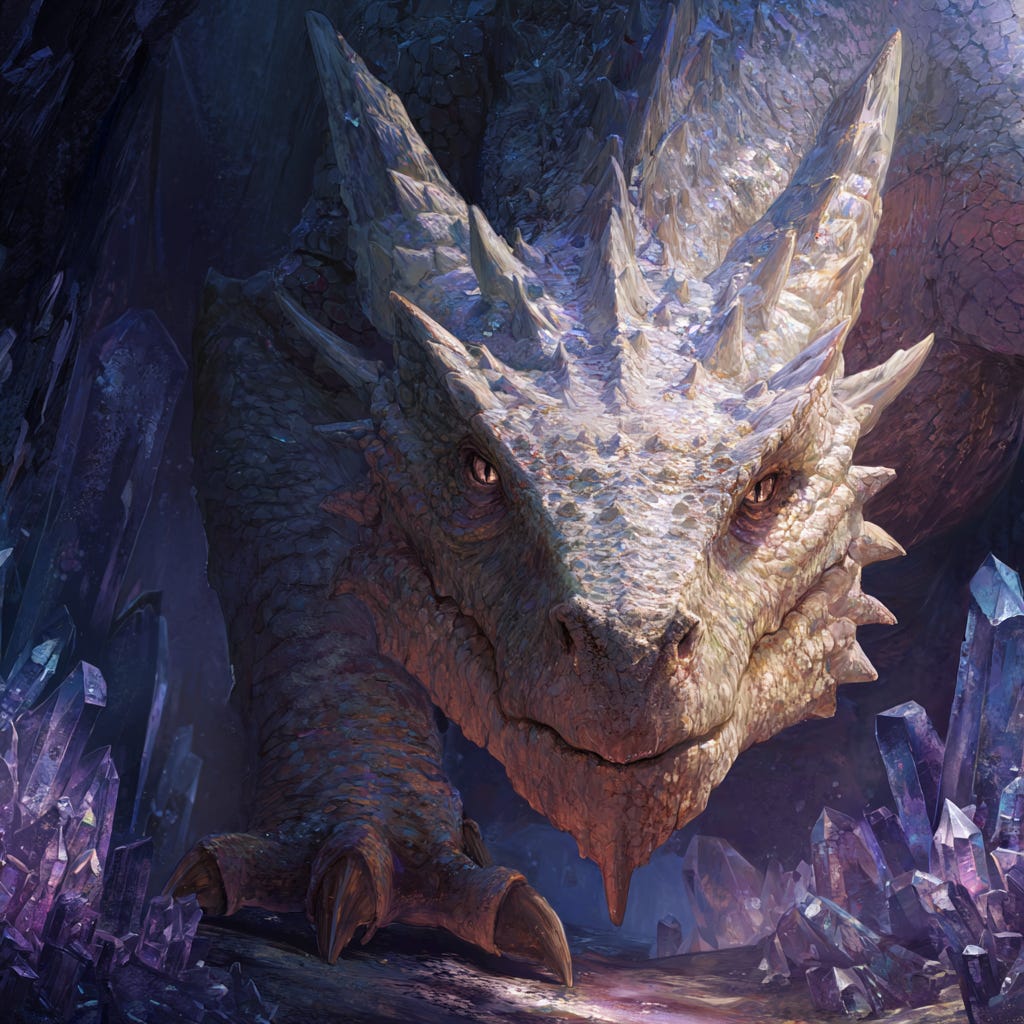
Among the draconic creation stories, Crystal Dragons have what might be the most optimistic and self-congratulatory interpretation of their origins. While they acknowledge their place within the broader narrative of Ryujin and the Astral Dragon’s collaboration in creating the Gem Dragons, they view their own emergence as the culmination and perfection of the creative process rather than simply its conclusion:
Following the spark that ignited the Universe and set the celestial spheres in motion, Ryujin, Tiamat, and the Astral Dragon turned their attention to populating creation with conscious beings who would appreciate and enhance its beauty. They began their work with the Gem Dragons, creatures designed to embody wisdom, balance, and insight in crystalline form.
The first breeds came forth— Amethyst, Topaz, Emerald —each magnificent in their own right, each a testament to the creators’ skill. Yet as the three creators observed their creations, they recognized that something remained incomplete. Each breed possessed remarkable strengths but also subtle limitations that prevented the perfect synthesis they had envisioned.
The Amethyst Dragons wielded tremendous arcane power but could be inflexible in their thinking, their wisdom sometimes hardening into rigidity. The Topaz Dragons demonstrated practical intelligence of the highest order but occasionally lacked the imagination to see beyond the obvious. The Emerald Dragons achieved admirable balance in all things but allowed their caution to inhibit the bold experimentation that drives innovation.
As the three dragon gods continued their work, each new Gem Dragon breed incorporated lessons learned from previous attempts. Sapphire Dragons improved upon Amethyst rigidity, Diamond Dragons enhanced Topaz practicality, Ruby Dragons refined Emerald balance. Yet with each creation, the divine architects recognized that they drew ever closer to their true goal without quite achieving it.
The creators spent considerable time in contemplation before attempting their final creation. They reviewed all they had learned from each previous breed, identifying not just the strengths and weaknesses but the underlying principles that governed the balance between wisdom and innovation, between power and agility, between careful thought and joyful experimentation.
When at last they felt prepared to attempt their ultimate creation, they gathered the finest crystalline formations from across the newly formed Earth. Into these perfect structures, they poured not merely their individual gifts but the accumulated wisdom gained from creating all previous Gem Dragon breeds.
From this crystalline matrix emerged the first Crystal Dragon, and the creators knew immediately that they had succeeded beyond even their own expectations.
The being before them embodied wisdom without rigidity, for its boundless curiosity ensured constant questioning and exploration. It possessed power without arrogance, for its smaller size taught humility while its arcane abilities demonstrated that true strength lies not in physical mass but in innovative application. It showed balance without timidity, for its experimental nature drove it to push boundaries while its crystalline clarity allowed perfect assessment of risk and reward.
Most importantly, the first Crystal Dragon possessed something none of the previous breeds had achieved in quite the same measure: a near-infinite capacity for wonder and joy. Where earlier Gem Dragons might grow somber with accumulated wisdom, this new creation approached existence with enthusiasm that would never diminish. Where others might become possessive of knowledge gained, this being delighted in sharing discoveries and collaborating with any who showed interest.
The gods spent considerable time observing their final creation, marveling at how perfectly it embodied their original vision. The Crystal Dragon’s mastery over light itself represented the ultimate expression of clarity and insight; the ability not just to see truth but to reveal it to others through prismatic display. Its experimental approach to arcana demonstrated the perfect synthesis of careful consideration and bold innovation they had sought to achieve. Its smaller size proved optimal rather than limiting, allowing for unmatched agility and preventing the territorial aggression that plagued some larger breeds.
As they watched the first Crystal Dragon explore its abilities, creating breathtaking light displays and inventing entirely new applications of arcane power simply for the joy of discovery, they spoke what has become known among Crystal Dragons as The Declaration of Perfect Synthesis:
“Behold, the culmination of our creative endeavor. In you, we have achieved what we sought from the beginning: a being who embodies wisdom without losing wonder, who wields power without seeking dominance, who pursues knowledge not to hoard but to illuminate.”
“Your optical abilities are not merely tools but cosmic instruments designed to reveal the hidden beauty inherent in all creation. Your experimental nature is not recklessness but the divine spark of innovation that prevents stagnation and drives all creation forward. Your boundless curiosity is not a distraction but the key to genuine appreciation of existence itself.”
“Where other breeds may grow weary with age, accumulating wisdom but losing enthusiasm, you shall retain forever the capacity for delight in new discoveries. Where others may become possessive of their knowledge and territories, you shall find joy in collaboration and sharing. Where others may view perfection as a destination to reach, you shall understand it as a process of constant exploration and refinement.”
“You are the point at which our vision became reality. No further refinement is necessary, for in you, we have achieved the ideal balance we sought.”
“Go forth and explore, experiment, innovate, and above all, maintain your capacity for wonder. For in your joy lies the justification for all creation, in your curiosity resides the engine of cosmic progress, and in your willingness to share discoveries rests the hope for true collaborative advancement of all conscious beings.”
Thus, Crystal Dragons view their existence not merely as the conclusion of the creation process but as its triumphant achievement, the point at which the creators’ vision finally manifested in perfect form.
This understanding shapes every aspect of Crystal Dragon society and philosophy. Their experimental approach to the arcane stems from the belief that they were specifically designed to push boundaries and discover new possibilities. Their collaborative nature reflects their role as beings meant to share knowledge rather than hoard it. Their perpetual enthusiasm demonstrates their fulfillment of the divine mandate to maintain wonder throughout existence.
Of course, no other dragon breed accepts this interpretation of events. Emerald Dragons point out the convenient nature of a creation myth that positions its believers as the pinnacle of divine achievement. Sapphire Dragons note that many claimed “improvements” could equally be viewed as limitations: smaller size as weakness rather than optimization, experimental chaos as lack of discipline rather than innovation.
Diamond Dragons provide one of the most pointed critiques, arguing that if Crystal Dragons truly represented the ultimate achievement, one would expect them to demonstrate clear superiority in practical applications rather than merely theoretical claims. They observe that Crystal Dragons have never dominated draconic society, never achieved the widespread recognition one might expect from genuinely superior beings.
Crystal Dragons respond to such criticism with their characteristic combination of intellectual confidence and playful dismissal. They argue that their critics demonstrate precisely the limitations the creation process was designed to overcome: the rigid thinking of Amethyst Dragons, the territorial competitiveness of Diamond Dragons, the inability to appreciate innovation beyond conventional measures of dominance or recognition.
More philosophically, Crystal Dragons suggest that true perfection cannot be measured by dominance or status but by the ability to find genuine fulfillment in existence itself. They point to their own boundless curiosity, creative enthusiasm, and capacity for wonder as evidence that they have achieved something more valuable than mere power. They have achieved the ability to truly appreciate the magnificence of creation.
The most sophisticated Crystal Dragon theologians have developed interpretations emphasizing their role as “cosmic appreciators,” beings whose very existence serves to recognize, celebrate, and enhance the inherent beauty of reality. According to this view, their optical abilities and experimental enthusiasm are not personal characteristics but cosmic functions, essential elements in the grand design of creation itself.
Whether these claims represent genuine cosmic insight or elaborate self-justification remains a matter of considerable debate among draconic scholars. What cannot be disputed is that the Crystal Dragon creation story has profoundly shaped their approach to existence. They are eternally optimistic, boundlessly curious, and genuinely convinced that their perspective on reality is not only valid but essential for the proper appreciation of existence itself.
And perhaps, in the end, that conviction— that absolute certainty in the value of joy, wonder, and collaborative discovery —is itself evidence of the creators’ success in achieving their ultimate vision.
And now it’s over to you, my friends. What are your thoughts on my conception of Crystal Dragons? Do you see parallels with other fictional dragons you’ve encountered? Are there aspects of their whimsical nature and innovative spirit you find particularly intriguing? How do you think their experimental enthusiasm would manifest in encounters with scholars, inventors, or other intellectually curious individuals?
Thank you for reading The Dragon's Lair!
If you're enjoying this deep dive into dragon breed characteristics, please consider sharing these articles with others who appreciate thoughtful fantasy worldbuilding. Each installment reveals new layers of the sophisticated societies and remarkable individuals that make up the draconic world, building toward a comprehensive understanding of how wisdom, power, and responsibility interweave in the lives of these magnificent creatures.
If you enjoyed this and you’d like to give me a one-time tip, you’re welcome to buy me a coffee:
Until next month, when we’ll explore a fascinating (though sadly extinct) breed of unclassifiable dragon called Sonic Wyrms, may your curiosity never dim and your experiments always yield beautiful results!
But stay tuned! Next week we’ll be continuing with the next episode of Bronze Horizons.
In the meantime, I hope to see you in the chat.
Have a lovely day.
Leave a comment below—I’d love to hear your perspectives on these delightfully Chaotic Crystals.